Materials Engineering – A "hot" field of study favored by tech-savvy young people.
Materials Engineering is the field of research and development of methods for manufacturing and processing materials with the aim of obtaining new materials with superior properties, environmental friendliness, and economic efficiency, meeting the ever-increasing needs of humanity. Materials Engineering is currently one of the four leading scientific and technological advancements in the world. Therefore, it is attracting the attention of young people with its wide-ranging opportunities and desirable income levels.
The training program follows the CDIO approach.
The Materials Engineering program at the Faculty of Building Materials, Hanoi University of Civil Engineering, is built on the CDIO (Conceive - Design - Implement - Operate) approach, emphasizing the education of a solid foundation in natural and technical knowledge to enable students to develop from the formation, design, implementation, and operation of ideas , effectively meeting the practical needs of society.
In the first two years, students are equipped with sufficient basic and broad foundational knowledge. In the third and final years, students are equipped with the scientific basis of the field, specialized knowledge, and knowledge of major material groups such as: inorganic materials, ceramic materials, polymer-composite materials, energy materials, and advanced materials such as: nanomaterials, thin film materials…
Alongside theoretical training, students regularly participate in practical training at the school and visit and intern at companies and research institutes such as Samsung, Vigracera, Hoa Phat, Vingroup, the Vietnam Academy of Science and Technology, etc. In addition to specialized knowledge, students are also given comprehensive development of personal and professional skills such as teamwork skills, communication skills, leadership skills, etc.
A flexible training model that meets student needs.
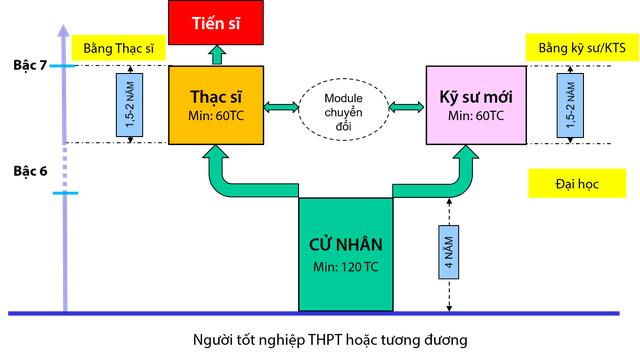
In 2020, the University of Civil Engineering began transitioning its training model to align with the Vietnamese National Qualifications Framework, which includes three levels:
Level 6 - University level : The course consists of 130 credits, and graduates receive a bachelor's degree.
Level 7 - Master's degree , includes:
Master's degree program , with a course load of 60 credits, awards students a master's degree.
The Engineer/Architect level program , with a course load of 60 credits (referred to as the new Engineer level), awards the student an Engineer/Architect degree.
After graduation , students can transfer their knowledge between an engineering/architecture degree and a master's degree.
Level 8 - Doctoral level : Upon successfully defending their dissertation, students will be awarded a Doctor of Philosophy degree.
In particular, the four-year bachelor's degree program in engineering will help students shorten their study time and quickly enter the labor market.
Click to enlarge the image
Model of conversion training programs at the University of Civil Engineering
The Bachelor of Materials Science program aims to train graduates with the necessary competencies and skills to participate in solving problems related to the conception, design, implementation, and operation of production processes, applications, and research and development of materials and new materials; increasing the efficiency of material use, contributing to environmental protection and sustainable development; and meeting the country's development needs in the context of the Fourth Industrial Revolution and international integration.
The new Materials Science and Engineering training program aims to train materials science and engineering engineers with in-depth competencies and skills to lead the solution of problems related to the conception, design, implementation, and operation of production processes, applications, and research and development of materials and new materials; increase the efficiency of material use, contribute to environmental protection and sustainable development; and possess the capacity for scientific research, innovation, and creativity to meet the country's development needs in the context of the 4.0 industrial revolution and international integration.
An advanced, internationally-standardized training environment.
With over 60 years of training and 50 years of development, the University of Civil Engineering has become a multidisciplinary university, a center for research and application of scientific and technological advancements, and a training institution offering programs from undergraduate to doctoral levels. At the University of Civil Engineering – a university accredited internationally (HCERES) – students will inherit an advanced and modern education, keeping pace with the development trends of both domestic and international markets.
Students study and conduct research in a high-quality, standardized university education environment, with a highly qualified faculty trained at prestigious universities and research institutes both domestically and internationally. The Faculty of Building Materials boasts a team of dedicated, experienced, and highly accomplished staff in teaching and scientific research, including 2 Professors, 8 Associate Professors, 3 Doctors of Science, 14 PhDs, and 16 Masters.
Click to enlarge the image
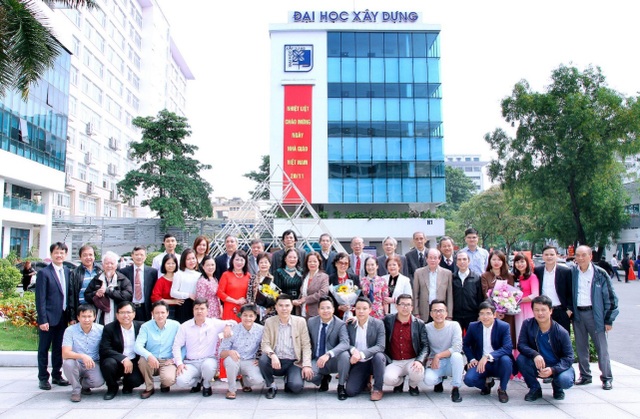
The faculty of the Department of Building Materials, Hanoi University of Civil Engineering
Career opportunities are abundant, with a 100% employment rate upon graduation.
After graduation, bachelor's and engineering graduates in materials engineering have many career development opportunities, such as continuing their studies at the master's and doctoral levels; working in partner organizations in the fields of inorganic materials, ceramic materials, polymer-composite materials, energy materials, and nanomaterials, such as:
Operations and management at domestic and international industrial companies and corporations.
Design, supervision, and installation in material manufacturing plant projects.
Working in state management agencies in the field of materials.
Teaching and research at universities, colleges, and research institutes related to materials science.
Working in agencies responsible for managing and inspecting the quality of materials, such as: Customs, and the Center for Standards, Metrology and Quality.
With extremely affordable tuition fees, averaging around 1.1 million VND/month, it creates favorable conditions for students with a passion for engineering. In addition, students with good academic performance have the opportunity to receive attractive scholarships from organizations and businesses operating in the materials sector, scholarships from alumni of the Faculty of Construction Materials, and academic achievement scholarships from the University of Construction, etc.



![[TUYỂN DỤNG] NHÀ MÁY GẠCH MEN MIKACO](/images/ckeditor/images/z6853140567376_7c8ea3f3b079510c2bf62c7b30948189.jpg)
![[TUYỂN DỤNG] NHÀ MÁY BÊ TÔNG AMACCAO](/images/ckeditor/images/Th%20ng%20Tuyn%20dng-h%60inh%20nh-0.jpg)