Author: Assoc. Prof. Dr. Nguyen Nhu Quy, former Lecturer in the Department of Building Materials Technology, Faculty of Building Materials.
(Continued)
Having accidentally read the poem "Night Comes to the Da River" by Thuc Ha, I wondered what connected me to this majestic and poetic river; perhaps it was destiny.
"Suddenly I lift my head, sparkling like a falling star.
I place my heart amidst the flowing water.
The blood—the river flowing through that heart—
will burst forth in countless shimmering waves…"
The names of people and places that were once unfamiliar to me now seem so familiar. There's Muong La, Ich Ong, Ban Penh, Nam Chien, Nam Mu. Then there are the specialties of the Northwest region like sweet bamboo shoots, ground bees, purple taro, and Hmong black chicken. And the Xoe dance of Thai girls in black silk skirts with their hair styled in high buns, mesmerized by the melodious sounds of the khene flute. And the stilt houses appearing and disappearing in the early morning mist, beautiful as a painting.
The more I travel, the more I realize that nowhere else has scenery as beautiful as my country, and nowhere else have people as kind and sincere as my compatriots.
I remember in mid-2006, I was summoned for an unexpected work trip to the Son La hydroelectric project. After half a day traveling along National Highway 6, traversing over 300 km of mountain passes, the van carrying the delegation pulled up in front of the Son La Hydroelectric Management Board. The Director of the Management Board – engineer T. – hurried towards us, his face looking more pensive than usual. A man who was usually calm, reserved, and approachable, rarely showing his emotions, I somehow sensed worry on his face today. Once seated in the living room, Engineer T. quickly discussed the recent incident at this monumental construction site with the delegation.
The contractor had just completed the construction of the diversion channel with tens of thousands of cubic meters of concrete. However, upon quality inspection, the concrete did not meet the required grade 200 as specified in the design. The incident was immediately brought to the attention of security agencies, who launched an investigation. According to unofficial information, approximately 60 security personnel were secretly deployed to monitor the construction of the Son La hydroelectric project. These could be workers, engineers, service staff, drivers, etc., acting as undercover agents gathering information and reporting it to security agencies tasked with protecting the project. Security agencies invited a reputable consulting company from Hanoi to Son La to conduct direct sampling of the diversion channel. The results of the sample tests showed a compressive strength of only 180 kgL/cmv, lower than the designed concrete grade. Further investigation revealed that the contractor had used PCB Mai Son cement, from a newly built cement plant in the Son La area, instead of the central government cement transported from the south. However, to produce this type of cement, they used clinker imported from China. The pozzolanic additive was sourced directly from Mai Son. The situation became complicated. In the worst-case scenario, if there was no solution, construction would have to be halted, and tens of thousands of cubic meters of concrete deemed substandard might have to be demolished. Of course, if that happened, it would have many repercussions: a series of officials and engineers could face disciplinary action or even criminal charges. That afternoon, the expert team of the State Council for National Construction met with the Board of Directors, the Management Board, and the contractor. The atmosphere was heavy, as if a storm was brewing. After many opinions were expressed from various sides, no conclusion was reached. It was my turn to present my viewpoint. All eyes were on me. At that moment, my voice trembled slightly from tension. I have confidently asserted that the concrete quality of the diversion channel fully meets the requirements based on specific scientific grounds:
1. The reason for the reduced concrete strength that I discovered was due to the replacement of central PCB cement with Mai Son PCB cement. This is because Mai Son cement has a higher water requirement, approximately 15% higher, due to the properties of the pozzolanic additive Mai Son added during grinding with Chinese clinker, which differs from the mineral additive used for central cement. The consequence is an increase in the water requirement of the concrete mixture and a reduction in concrete strength. In that case, when changing the type of cement, the contractor should have redesigned the concrete mix and made appropriate adjustments. However, they did not do so, simply increasing the amount of water in the concrete mix to achieve the necessary plasticity during construction. This resulted in a reduction in concrete strength.
2. On the other hand, according to the American ACI standard (at this stage, Vietnam did not yet have a standard for on-site concrete acceptance testing using direct drill samples), the strength of direct drill samples on the structural element only needed to reach 85% of the required design strength. Therefore, although the laboratory test results were lower than required, the direct test results, commissioned by the security agency, reached 180 kgL/cmv, equivalent to 90% of the required strength, which is completely acceptable.
Thus, the fuse that seemed to be hanging over everyone's heads was defused just in time.
As I saw the team of experts off to their bus back to Hanoi, the director of the Son La Hydropower Project Management Board shook my hand firmly. Looking into his eyes, I could read gratitude and admiration. He whispered in my ear, just loud enough for me to hear: "Thank you so much, Professor" (even though he was my contemporary and a former student of the University of Civil Engineering, now holding a high position overseeing nearly $4 billion of state investment). I also vaguely learned that this incident had cost the Project Management Board more than a third of the billion dollars, not to mention the hardship and psychological strain.
The more than 300 km journey back to the capital felt shorter to me that day. The car sped through the vast green expanse of terraced rice fields, the mango orchards of Yen Chau, and the breathtakingly beautiful Moc Chau grasslands. In life, everyone feels the greatest joy when they feel they have done something useful, however small.
(To be continued)
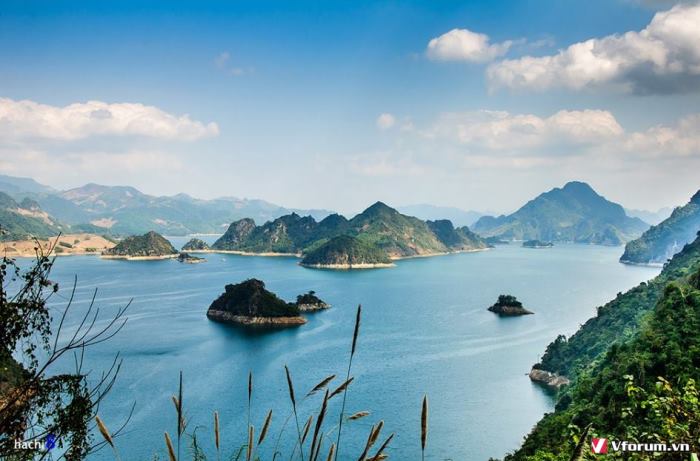
Hydroelectric reservoir on the Da River
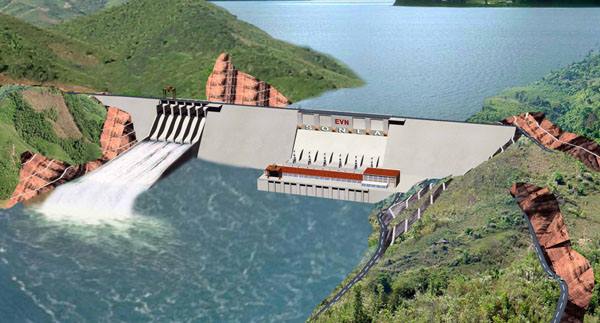
Rendering of the Son La hydroelectric power plant design.
 The Da River diversion canal was used for the construction of the Son La hydroelectric power plant.